Managing your own logistics can be costly and time-consuming, especially for Amazon FBA sellers and Shopify store owners. Third-party shipping services allow e-commerce businesses to outsource warehousing, order fulfillment, and shipping to specialists. A third-party fulfillment provider (3PL) receives your inventory, stores it, and picks, packs, and ships orders on your behalf. This means you don’t have to build your own warehouse team or negotiate carrier rates. As a result, you can focus on growing your sales while the 3PL handles order fulfillment.
For example, RitePrep is a U.S.-based third-party logistics fulfillment provider specializing in e-commerce and DTC brands. RitePrep’s experienced team and warehouse network let you ship efficiently while you focus on growing your business. These providers typically offer software that integrates with your sales platforms (Shopify, Amazon, etc.), so orders flow automatically from your store to the warehouse.
You’ll get a dashboard with real-time inventory and shipment tracking. This gives you visibility and control from wherever you are, freeing you to focus on marketing and product development instead of packing boxes.
Also Read: Online Store Fulfillment Service & E-Commerce Logistics
Third-Party Logistics Benefits
Outsourcing to a 3PL delivers clear advantages for DTC brands and online sellers:
1) Save Time & Money
You eliminate the costs of your own warehouse, staff, and equipment. No need to rent extra space or buy packing machines. With a 3PL, you pay per order instead. Many stores find that their cost per order drops once they reach scale.
2) Expertise & Support
3PLs hire logistics pros who optimize packing, negotiate carrier rates, and stay ahead of shipping trends. Instead of learning fulfillment from scratch, you tap into proven processes. This frees you to focus on marketing and growth.
3) Faster Delivery & Lower Cost
By splitting inventory across multiple warehouses (a strategy called distributed inventory), you ship orders from the nearest location and can reach most U.S. addresses in 2 days. The 3PL’s large shipping volume also secures carrier discounts, reducing your per-package cost. This means faster delivery without breaking the bank.
4) Advanced Inventory Management
The 3PL tracks your stock in real time. You get dashboards showing how much inventory is in each warehouse. This third-party logistics inventory management lets you prevent overselling and know exactly when to reorder.
5) Focus on Growth
Outsourcing fulfillment frees your team to work on sales, new products, and customer outreach rather than packing boxes. As Red Stag notes, a 3PL lets you “focus your resources on growth activities” such as marketing and product development.
These benefits explain why so many brands, from startups to Fortune 500s, use 3PLs. In fact, U.S. businesses spend roughly $400 billion per year on third-party logistics to streamline their supply chains.
Also Read: E-commerce Order Fulfillment Service
Key Services Offered by Third-Party Shipping Providers
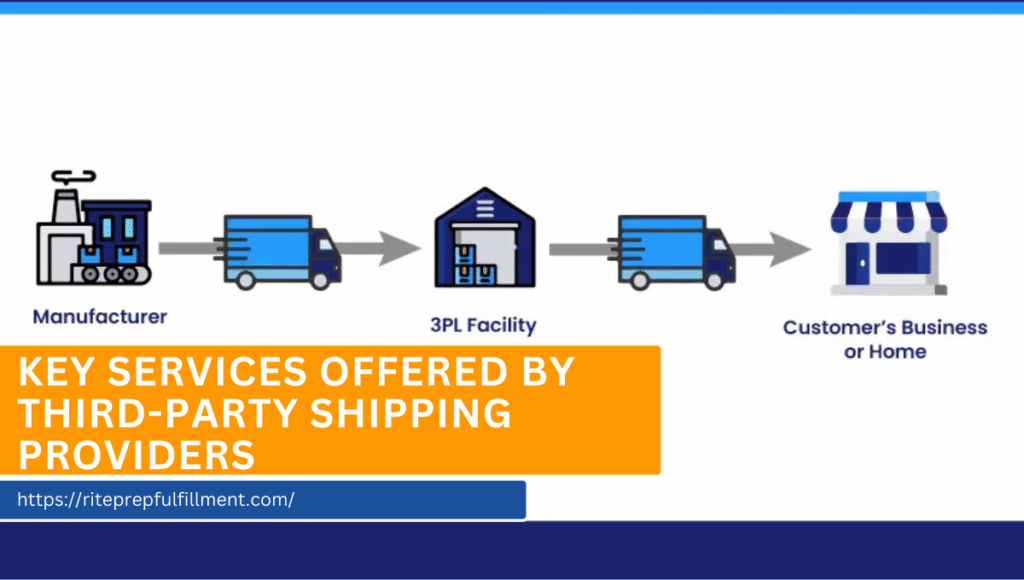
3PL companies offer a wide range of services. Common offerings include:
1) Order Fulfillment (Picking, Packing & Shipping)
The 3PL handles each order from start to finish. When a customer buys a product, the 3PL picks the item, packs it in a box, and ships it out. They manage all carrier relationships and typically pass on bulk shipping discounts to you.
2) Warehousing & Storage
Your products are stored in the 3PL’s secure, climate-controlled warehouses. You only pay for the space and services you use, without worrying about facility management. Some centers offer specialized storage (e.g., cold storage or pallet racking) to fit your inventory.
3) Inventory Management
The 3PL tracks your inventory across all warehouses. A good 3PL will sync stock levels with your online store so inventory counts update automatically. This helps prevent overselling and stockouts. You’ll also get data on which products are selling fastest, helping you plan reorders.
4) Kitting, Packaging & Branding
3PLs can assemble product bundles or subscription boxes. They’ll group multiple SKUs into one shipment and apply any special packaging you provide. They can also add branded inserts, custom labels, or marketing materials to every box, giving customers a memorable unboxing experience.
5) Returns Processing
Many 3PLs handle returns on your behalf. They will inspect returned items, restock them if they’re sellable, or follow your instructions for disposal or liquidation. This reverse logistics service closes the loop on orders and saves you from having to deal with returns yourself.
6) International Shipping & Customs
If you sell abroad, some 3PLs offer global logistics support. They handle freight forwarding, customs clearance, and taxes, simplifying international orders. An international 3PL “leverages technology to create a seamless connection” between your store and global shipping, streamlining complex processes. Such a third-party shipping service provider manages the paperwork and carriers, so you don’t have to.
Each 3PL is different, so make sure they offer the services you need. For example, RitePrep Fulfillment provides U.S. warehousing, integrated inventory management, and these fulfillment services tailored for e-commerce. For more details, see our Fulfillment and Shipping page.
Choosing the Best Third-Party Shipping Company
When evaluating 3PL partners, consider these factors:
1) Scalability & Coverage
Can the 3PL grow with you? Check if they have multiple warehouse locations and enough labor to handle peak seasons. Ideally, they support all your sales channels (webstore, marketplaces, retail, and dropshipping) seamlessly.
2) Technology & Pricing
A quality 3PL will offer a robust software platform so you can track orders and inventory in real time. Ask for transparent pricing, including pick/pack fees and shipping rates. Hidden fees can eat into your margins, so clarity is key.
3) Location & Delivery Speed
Look at warehouse locations. A U.S.-based 3PL with East and West coast centers can reach most U.S. customers in 2 days. If you have international customers, choose one with global or cross-border capabilities.
4) Customer Service
Responsive support is a must. Does the 3PL offer a dedicated account manager? Do they have weekend or 24/7 support? Reading client reviews can help gauge reliability.

For example, RitePrep Fulfillment is known for excellent support and fast shipping to U.S. customers. Learn more on our 3rd Party Logistics & Warehousing page.
| Feature | In-House Fulfillment | Third-Party Logistics (3PL) |
| Upfront investment | High (warehouse, equipment, staff) | Low (pay-as-you-go for services) |
| Scalability | Limited by internal capacity | Easily scales (ramps up resources) |
| Expertise required | You manage all logistics | Provided by expert 3PL staff |
| Delivery speed | Depends on your locations | Often faster (networks of warehouses) |
Choosing the right partner means comparing criteria like pricing, technology, and support to find the best third-party shipping company for your business. With a U.S.-based 3PL like RitePrep, you can offload logistics and focus on growth.
Third-Party Fulfillment Centers & Inventory Management
Top 3PLs operate multiple fulfillment centers. By distributing inventory across these centers, they can ship orders from the nearest location, cutting transit times and costs. For example, RitePrep’s centers on the East and West Coasts enable 2-day ground shipping to almost any U.S. address.
At the same time, 3PLs offer real-time inventory tracking. You can log in and see stock levels in every warehouse. This third-party logistics inventory management means you avoid stockouts and always know how many units you have on hand.
Also Read: E-commerce Order Fulfillment Service
American Third-Party Logistics Services
If you sell in the U.S., choosing American third-party logistics services can give you an edge. U.S. 3PLs know domestic regulations (taxes, labeling, etc.) and shipping zones. They usually have warehouses near major ports and population centers to speed up delivery.
Many global brands rely on U.S. 3PLs; even Fortune 500 companies spend about $400 billion on American 3PL services each year. With American fulfillment centers on both coasts, you can reach nearly every U.S. address in two days.
Red Stag notes that placing warehouses near major East and West Coast ports also keeps drayage costs low. By using a U.S.-based 3PL like RitePrep, you get that same advantage: faster ground shipping and localized compliance support. For U.S. sellers, working with an American 3PL also means dealing in local time zones and regulations, making communication and compliance smoother.
Companies That Use Third-Party Logistics
Almost any product-based business can benefit from a 3PL. BigCommerce notes that companies using 3PLs often tap into advanced forecasting and reporting tools. Common examples include:
1) Online Retailers
Amazon FBA sellers, Shopify stores, and other e-commerce businesses outsource fulfillment so they can scale without building in-house logistics.
2) Subscription Box & DTC Brands
These companies need reliable monthly shipping. They rely on 3PLs to assemble boxes (kitting) and deliver them on schedule.
3) Manufacturers & Wholesalers
Instead of building warehouses, product makers and wholesalers often hire 3PLs to store and ship products to distributors or end customers.
5) Brick-and-Mortar Retailers
Stores that want an online presence can tap a 3PL to handle e-commerce orders without tying up their own staff or space.
6) Seasonal & High-Volume Sellers
Companies with holiday or seasonal spikes (e.g., holiday decor, Black Friday sales) use 3PLs to handle surge volumes without hiring permanent staff.
7) Crowdfunded & DTC Startups
Kickstarter or Indiegogo projects, and new direct-to-consumer brands, often partner with 3PLs to fulfill large initial orders when launching products.
In short, if you sell products (whether B2C or B2B), a good 3PL can streamline your entire supply chain. For growing companies, a 3PL essentially becomes an outsourced shipping department, allowing you to scale without logistical headaches.
Ready to streamline your fulfillment? Contact RitePrep Fulfillment today for a free quote and see how our third-party shipping services can support your growth!
Frequently Asked Questions
What is a third-party shipping company?
A third-party shipping company (3PL) is a logistics partner that fulfills orders for you. You ship your products to the 3PL’s warehouse, and they handle storing and delivering the packages. As Amazon explains, 3PL providers “will pick, pack, and ship goods on your behalf.” In other words, a third-party shipper acts like an in-house shipping department for your business.
Is Amazon a 3PL or 4PL?
Amazon primarily operates as a 3PL for its sellers through services like Fulfillment by Amazon (FBA). These programs warehouse your products and ship them to customers, fitting the 3PL model. Amazon itself is not typically called a 4PL (which would be a logistics integrator overseeing multiple providers).
What is an example of a 3PL?
Many companies serve as 3PL providers. For example, DHL Supply Chain is a global 3PL offering warehousing and shipping. FedEx Supply Chain is another example. In e-commerce, firms like ShipBob and Red Stag Fulfillment act as 3PLs for online sellers. Even Amazon’s FBA service is essentially a 3PL solution. These companies all handle fulfillment for other businesses.
What does “third-party shipment” mean?
A third-party shipment is one where the shipping bill is sent to someone other than the sender or recipient. UPS defines it as “UPS bills shipping charges to a party other than the shipper or receiver.” In practice, this often means the seller (or their 3PL) pays the freight instead of the buyer or original shipper.
Who pays for 3rd party shipping?
In a third-party shipping arrangement, the designated third party covers the shipping costs. Typically, this is the seller or the 3PL. For example, if UPS delivers on a third-party account, UPS will invoice the party specified on that account (often your company or your 3PL), not the sender or receiver. In most e-commerce cases, that means the merchant pays the freight bill (though they may bundle it into the product price).
Is DHL a third-party logistics?
Yes, DHL is one of the world’s leading third-party logistics providers. It offers a full range of 3PL services such as warehousing, fulfillment, and transportation. In fact, DHL often ranks as the top 3PL provider globally by revenue.